


|
|
|||||||||||||||||||
 |
|||||||||||||||||||
|
Case 16 addresses the Nutrition Care Process during palliative and hospice care. The four phases of Lillie's care reflect the first four of the five phases of palliative care described in Table 2 of the Perspective. As you work through the information below, consider the dietitian's focus during Phase 1 of Lillie's progress. What are the key issues for consideration in terms of nutrition care? What questions will the patient and her caregiver be asking?
Lillie is a 73-year-old retired oncology nurse. She has breast cancer which has metastasised to her bones, liver and lungs. Lillie lives alone in her one-story home. Her son lives approximately 1 120 km (700 miles) away and visits her once or twice per year. Her next-door neighbour, Evelyn, is her main support and primary caregiver. Evelyn stops by several times a day to assist in Lillie's care. Two years (April to September) prior to her passing, Lillie, who had been unable to eat for an extended period, was transitioning back to a soft food diet under the guidance of her dietitian. In addition to her oral intake, she was tolerating three 250 mL cans of 2 Cal PEG feeds daily. (See Case 9: Home Enteral Nutrition for additional details). The timeline of Lillie's care going forward, falls into four phases.
|
|
||||||||||||||||||
|
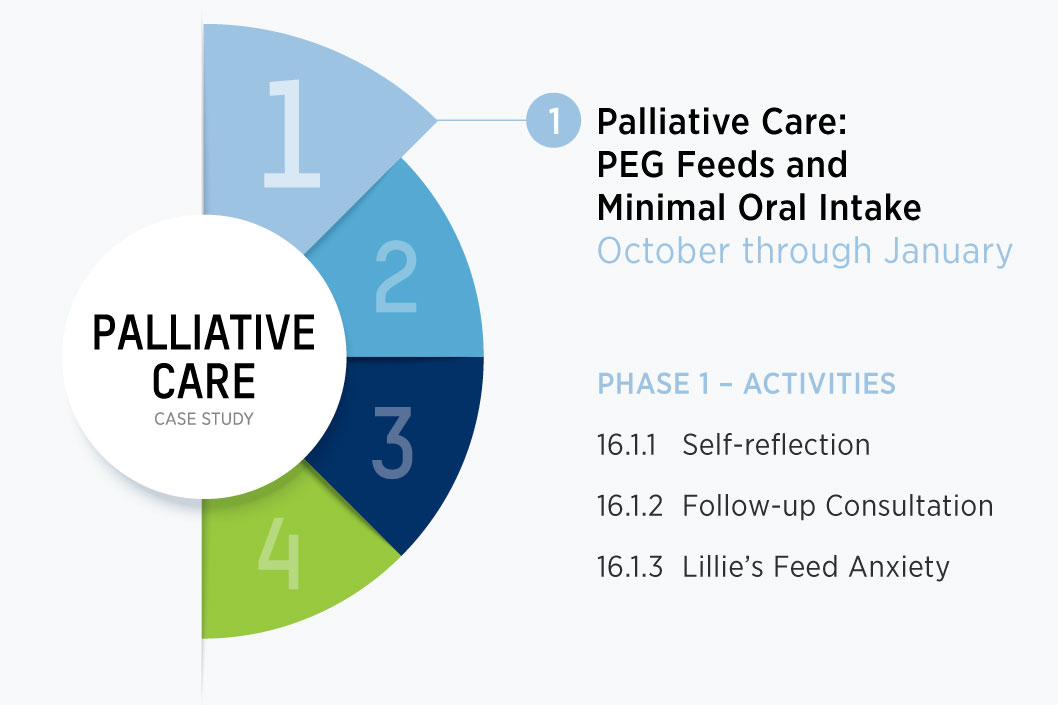
PHASE 1 - OCTOBER THROUGH JANUARY
PEG FEEDS AND MINIMAL ORAL INTAKE |
|||||||||||||||||||
|
18 months prior to her passing, Lillie's chemotherapy treatment was delayed multiple times due to her compromised immune system. From October to January before she passed away, Lillie ceased to tolerate oral food and beverages due to oesophageal complications and vomiting. During this four month period, she relied on enteral nutrition as her sole source of nutrition.
The volume of formula she tolerated varied from day to day. She aimed to have three 250 mL cans of 2 Cal/mL feed daily, but managed to consume this only four days a week. On the other three days, she consumed one or two cans.
Her physician's focus during this period was on maintaining her quality of life. By and large, her condition was stable during those months, reflecting Phase 1 of the Palliative Care progression.
Unfortunately, during this time, Lillie's feeding equipment failed. The feed pump tubes regularly disconnected during night feeds, resulting in Lillie having to rise to change her sheets and clean her room. This caused her a great deal of distress and anxiety. Lillie didn't want to disturb her caregiver during the night. Eventually, she resorted to sleeping in her reclining chair to be sure that she didn't have a mess to clean in her bed.
The dietitian is required to provide advice on the feed pump. It is also their role to encourage Lillie to enjoy any foods she might like and to encourage enteral nutrition, as long as Lillie wishes to continue it. |
|
||||||||||||||||||
|
Lillie's Feed Anxiety
|
|||||||||||||||||||

|
|

___________________________________________________________________________________________________
|
|
Click HERE to proceed to Phase 2 |
.jpg)